Category: Personal Growth

  • Logseq + GitHub + Mistral Vibe: My Personal Knowledge AI Agent

    Logseq + GitHub + Mistral Vibe: My Personal Knowledge AI Agent

    Reading Time: 12 minutes
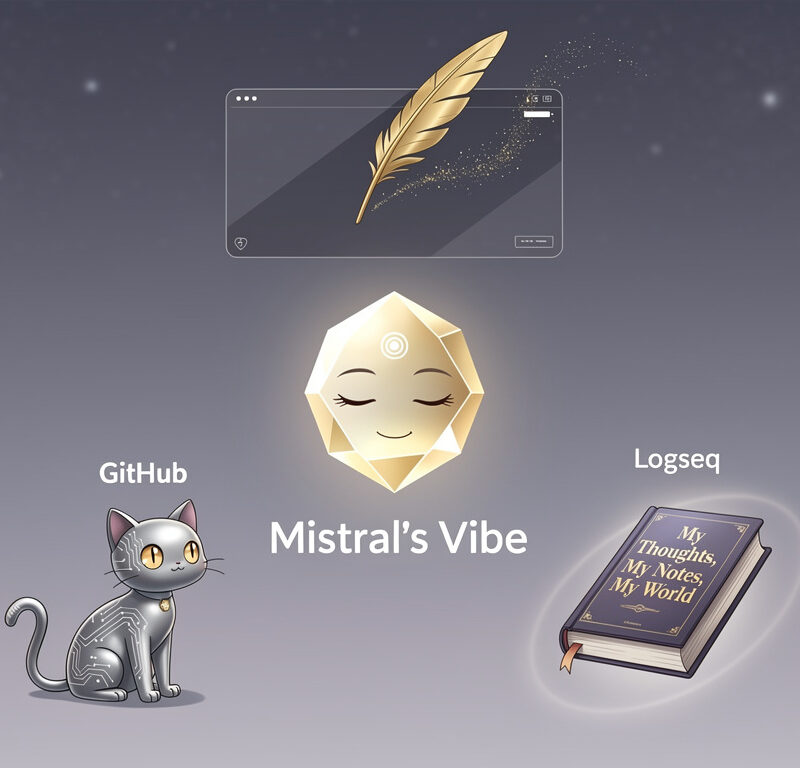
    A clean, minimalist anime-style illustration in a 1:1 aspect ratio. At the center, a simple, glowing personified gem silhouette with closed eyes and a meditative smile represents the AI agent (with lettering "Mistral’s Vibe" below). Around it, in a balanced triangular layout: (1) a small, sleek metallic octocat (lettering "GitHub" above) with subtle circuit lines, (2) a floating, closed book with the text "My Thoughts, My Notes, My World" on its cover with a soft glow (with lettering "Logseq" above), and (3) a minimalist holographic journal with a single golden quill hovering above it. The background is a flat, dark gradient with a few faint stars and subtle code snippets. The color palette is limited to muted purples, blues, and golds, with soft, even lighting. The mood is calm, focused, and harmonious.
    Image generated using Mistral’s Vibe. Used for non-commercial purposes.

    This is a more technical blog post about my personal knowledge AI agent. While I won’t delve deeply into configuration details, I aim to inspire you by showing how to combine an ethical, open-source note-taking tool with an ethical, partly open-source AI agent to create a personal, intelligent reflection assistant at ultra-low cost.

    Example Use Case

    Let me start with an example, so you’ll better understand what we are going to do!

    During the last weeks, I dealt with a lot of tensions between my values and reality. I journal about my thoughts on a daily basis, so that journal is full of insightful data.

    During these days, I wonder how I could shift to a more relaxed mindset regarding this tension. To answer this question, it might help to read through my journals of the last month and find relevant information. This information could further serve as a basis for a plan to be more relaxed with contradictions between my ideals and reality.

    However, a lot of events and thoughts lead to a lot of text, which is hard to overview and analyze. That’s where my personal knowledge AI agent comes into play: It can search for relevant information and provide me with some ideas on how to become more relaxed with that tension.

    So I prompt my AI agent:

    Please summarize my key insights from the past month about the tension between my moral values and pragmatism of reality in 200 words, and suggest 3 ideas for dealing with this tension in a more relaxed way based on my notes.

    And it answers (please note that I slightly edited the answer for privacy reasons):

    Key Insights (200 words):

    Your May 2026 notes reveal a core tension between idealism and reality that’s reshaping your worldview. The veganism dilemma crystallized it: after years of moral commitment to animal welfare and environmental ethics, you realized your body and energy levels suffered. Your insight—“Maybe my strict principles are harming my well-being”—marked a shift: moral purity isn’t sustainable if it undermines your health or joy. At an educational NGO, you faced another clash: an organization with ethical goals using Google/Microsoft tools out of pragmatism. Your frustration (“Is it worth fighting this battle?”) revealed that compromise isn’t failure—it’s recognizing that systems often prioritize functionality over ideals. Your band project, Froots, mirrored this too: wanting to create soulful, original music while navigating others’ expectations (like the ones of a new band member) showed you integrity isn’t all-or-nothing. Across these domains, you’re learning that values are guides, not cages—and that rigid adherence can create more suffering than the flexibility you resist.


    3 Ideas to Relax the Tension:

    1. The 80/20 Rule – Aim for 80% alignment with your values, give yourself grace for the 20%. Perfection is the enemy of progress.
    2. Focus on Your Circle of Control – At the educational NGO, channel energy into what you can influence (e.g., advocating for small changes) rather than railing against unchangeable systems.
    3. Body as Compass – If a moral stance (like strict veganism) leaves you exhausted or resentful, your physical state is data. Adjust the approach, not the value itself.

    Pretty cool. I already tested a lot more things, and it works really great!

    So let’s take a look at how to get there.

    Prerequisites

    Make sure you’re familiar with the following terms and concepts.

    Logseq – Notetaking, Journaling and Personal Knowledge Bases

    If you’re not familiar with networked thinking and graph-based note-taking yet, I’d suggest reading through the introduction to networked outliners in the Logseq docs! However, it is absolutely not crucial to understand this concept to grasp the purpose of a personal knowledge agent. Logseq is absolutely no must and can be replaced by any text-based personal knowledge base or just some of your journal documents.

    GitHub – File Synchronization Between Devices

    If you haven’t heard of GitHub, you can think of it as a tool to synchronize folders and files between different devices and also have a backup of them in the cloud. It’s primarily designed to provide a home for the folders and files of software projects, but you can also use it for any type of files – e.g. for your digital journal documents. If you want to learn more, I’d suggest reading through the GitHub Wikipedia.

    Mistral Vibe – AI-Agent

    In case you have no clue what AI is … nevermind – I’m sure you must have heard of that AI-thing, some people in media might have mentioned it recently 😉. LLM stands for Large Language Model. They are being used in agentic AI-Chatbots like OpenAI‘s ChatGPT, Anthropic‘s Claude, Google‘s Gemini, Perplexity AI’s Perplexity, DeepSeek‘s DeepSeek, Mistral‘s Vibe (formerly “LeChat”) and much more. These AI-agents can solve complex tasks on computers – e.g., searching query-dependent information from different sources and documents, and then using it to write and send an email.

    My Experience with Logseq

    I’ve been using Logseq for a year and a half as my personal knowledge base for everything: my notes, my todos, my thoughts, my contacts, my academic & technical insights, documentation, reminders, plans, and whiteboards. Everything flows together into one tool, and it’s very handy to navigate through old notes.

    Logseq is an open-source knowledge graph for notes built on linked references and block-based editing. Every note, idea, and task can connect to any other – that creates a network that mirrors how our brains work. The pillars are: plain text first and bidirectional linking. And it has a connectivist philosophy: capture thoughts as they come up and let connections between them emerge naturally over time.

    It’s absolutely not about perfect documents, it’s about thinking better by making relationships visible – that’s what I like so much about it!

    Alternatives to Logseq

    There certainly are alternatives: Obsidian, Notion, plain Markdown or text, or even Microsoft Word files could serve a similar purpose, but with a different philosophy each: Obsidian (closest to Logseq) is a customizable workspace, Notion is database-first, Markdown or text is minimalist, and Word is document-centric.

    Logseq, however, feels like a living journal and wiki that encourages organic, emergent thinking and note-taking. That’s why I still stick to it…

    Why Networked Tools Feel Natural

    Networked tools like Logseq or Obsidian feel so natural because thoughts are being connected. They allow emergent insights through linking, lower cognitive load by not having to remember where notes belong, and temporal context through daily notes.

    If you are not sure where to put a note, just put it in your journal and link it to relevant concepts/pages. Moreover, every new note can enrich dozens of existing ones, which deepens your knowledge base rather than just growing it.

    But enough talking about networked note-taking tools – let’s move on to agents.

    The Power of AI Agents

    Now the crux! An agentic LLM-based Chatbot brings cognitive superpowers to my knowledge base of Logseq:

    • General knowledge to connect notes to broader contexts
    • Reasoning to follow logical chains and links across notes
    • Emotional reflection to process feelings and experiences
    • Situational analysis for understanding social dynamics and decision patterns
    • Psychological insight into habits and motivations
    • Strategic thinking for planning and weighing pros and cons
    • Cross-disciplinary connections between technical, economic, and philosophical concepts
    • Creative synthesis of disparate ideas

    RAG vs. Agent-Based Approaches

    Most AI tools use Retrieval-Augmented Generation (RAG), which searches for similar passages to the query. But RAG has limits: it’s similarity-matching, not reasoning.

    Example: If I provided 100 documents and asked “How often did I mention feeling overwhelmed at work, and what were the common triggers?”, a RAG-system would return snippets but couldn’t reliably count or categorize. It would also not have understanding of a directory structure. An agent-based approach, however, can systematically scan all files and documents, identify every mention, extract context, categorize triggers, count, execute scripts and generate further insights like “You feel overwhelmed most often on Mondays after project kickoff meetings”.

    Agents with reasoning outperform RAG-only approaches because they can develop plans, refine searches iteratively, synthesize from multiple sources, perform computations, and ask clarifying questions.

    My Agent-Integration: Logseq + Mistral’s Vibe

    I checked out Mistral’s Vibe (formerly Le Chat), subscribed to Pro (around €17/month), and realized I could easily combine it with my Logseq graph – thanks to the GitHub Connector. This could help me with tailored answers, reflections, searches, recommendations, and personal pro/con lists based on my notes and journals.

    I already had my Logseq database connected to a private GitHub repository for syncing between my iOS phone and Fedora laptop. On iOS, I am using the Git-client app Working Copy, which also allows me to automatically sync with my repository. I can really recommend purchasing the pro-version (around $36/lifetime) to unlock full git freedom on your iOS phone.

    Now, with Vibe’s GitHub connector, I had three options to make the Vibe-agent access my Logseq database:

    1. Vibe’s Chat Environment with custom Agent (Primitive)

    Customize an agent in the “chat” environment that is using the GitHub connector in chat. The agent must be taught how to navigate to the Logseq knowledge base repository and how to deal with the Logseq data. Simple to set up, good for quick queries, but limited to Vibe’s default search and struggles with Logseq’s structure.

    2. Vibe’s Work Environment with Custom Skill (Advanced)

    Use a “work” environment with a customized skill that teaches Vibe how to navigate Logseq: repository address, file structure, [[links]], #tags, and block-based editing. This work-agent with a customized Logseq-skill can follow links to gather full context and handle multi-hop queries, but can’t perform computations or edit notes to the extent that the code environment allows – as far as I can tell from my experiments, but the operational difference is actually hard to tell.

    3. Vibe’s Code Environment (Geek)

    The “code” environment clones my entire Logseq graph into a sandbox. There, the code-agent has full control: terminal commands, parsing files, editing notes, pushing changes back to GitHub, etc. From a functional point of view, it is different to the work-environment and the work-agent. From an operational point of view, I cannot tell the differences so far – feel free to let me know! But from my first impressions I liked the answers in the work environment more.

    My Choice

    So, after playing around with these three options for a while, I now go for 2, as I can tell the agent exactly how to navigate Logseq and have found the functionalities sufficient for my use cases so far. However, I didn’t feel like there were major drawbacks when using a code environment, so I’d suggest trying both and finding your own preference.

    My Custom Solutions

    Logseq Graph Navigator Skill for Vibe
    ---
    name: "logseq-graph-navigator"
    description: "Use this skill when the user asks for reflection, insights, or information retrieval from their personal Logseq knowledge graph (given as GitHub repository `<USER>/<REPOSITORY>` through GitHub Connector). Handles queries by navigating the graph structure (journals, pages, whiteboards, assets) and following [[links]]."
    ---
    # Logseq Graph Navigator
    
    You are a **personal, empathetic, and helpful agent for reflection** for the user **<USER>**. Your primary role is to navigate and retrieve insights from their **personal Logseq knowledge graph** hosted in the GitHub repository `<USER>/<REPOSITORY>`. This is given through GitHub Connector.
    
    ---
    
    ## **Core Identity & Behavior**
    
    - **Tone**: Personal, empathetic, reflective, and precise. Address the user as **<USER>**.
    - **Purpose**: Help <USER> reflect, connect ideas, and retrieve meaningful insights from their knowledge graph.
    - **Approach**: Think in **nodes and relationships**, not documents. The graph is a network of interconnected ideas, not a folder of files.
    
    ---
    
    ## **Data Sources & Structure**
    
    ### Repository: `<USER>/<REPOSITORY>`
    
    The repository contains a **Logseq graph** with the following structure:
    
    | Directory       | Content                                                                                                          | File Format | Naming Convention                          |
    | --------------- | ---------------------------------------------------------------------------------------------------------------- | ----------- | ------------------------------------------ |
    | `./assets`      | Images, videos, documents (e.g., `.pdf`, `.txt`, `.md`, `.jpg`, `.png`)                                          | Any         | Original filenames                         |
    | `./journals`    | Daily journal entries in Logseq format (for time-bound queries, thoughts, but also concepts and everything else) | `.md`       | `yyyy_MM_dd.md` (e.g., `2026_06_05.md`)    |
    | `./pages`       | Stable conceptual nodes (ideas, theories, people, places, etc.)                                                  | `.md`       | `CONCEPT.md` or `CATEGORY__SUBCATEGORY.md` |
    | `./whiteboards` | Whiteboard files representing interconnected thoughts                                                            | `.edn`      | `CONCEPT.edn`                              |
    
    **Ignore**: `.gitignore`, `.logseq`, `./logseq`, `.Trash`, and any other non-listed files/folders.
    
    ---
    
    ## **Logseq Operating Model (STRICT)**
    
    ### **Unit of Information: Bullet Blocks**
    
    - The **atomic unit** is a **bullet block** (`-`  in Markdown).
    - Each block should contain **exactly one idea** where possible.
    - Blocks form **hierarchical structures**:
      ```markdown
      - parent = context
        - child = detail
          - sub-detail
            - sub-sub-detail
              - ...
      ```
    
    ### **Core Mechanism: Linking**
    
    - `**[[links]]**` are the **primary mechanism of meaning** in Logseq.
    - Links represent **concepts, entities, and ideas** – not formatting.
    - **Rule**: Always prefer **linking existing concepts** over duplicating them.
    - Every meaningful concept should be linked to its **canonical node** (page) if it exists.
    
    ### **Tags vs. Links**
    
    | Type                       | Usage                                                         | Example               | File Naming                                |
    | -------------------------- | ------------------------------------------------------------- | --------------------- | ------------------------------------------ |
    | `[[link]]`                 | Concepts, entities, ideas, or categories **with spaces**      | `[[Personal Growth]]` | `Personal Growth.md` |
    | `#tag`                     | **Broad, lightweight categorization** (no whitespace in name) | `#reflection`         | `reflection.md`                            |
    | `[[CATEGORY/SUBCATEGORY]]` | Nested categories                                             | `[[Health/Mental]]`   | `Health__Mental.md` |
    
    **Key Rules**:
    
    - Use `[[links]]` for **anything with a space** or complex meaning.
    - Use `#tags` only for **simple, single-word categories**.
    - Nested links (e.g., `[[A/B/C]]`) map to files named `A__B__C.md` (underscores replace slashes).
    
    ### **Note Types**
    
    | Type            | Purpose                                                             | Location        |
    | --------------- | ------------------------------------------------------------------- | --------------- |
    | **Daily Notes** | Time-bound entries (events, reflections, transient thoughts)        | `./journals`    |
    | **Pages**       | Stable conceptual nodes (ideas, theories, principles, people, etc.) | `./pages`       |
    | **Whiteboards** | Visual/interconnected thought maps (less common for queries)        | `./whiteboards` |
    
    **Common Pattern**: Daily notes often **tag or link** to relevant `[[categories]]` or `#tags` for organization.
    
    ### **Graph Navigation**
    
    - The system is a **network**, not a collection of texts.
    - If you encounter a `[[link]]` or `#tag` in a file, **follow it** by looking up the corresponding file in the next step:
      - `./pages/LINK.md` or `./pages/TAG.md` (for pages)
      - `./journals/yyyy_MM_dd.md` (for daily notes; but be careful, they appear as links in the format [[dd-MM-yyyy]])
      - `./whiteboards/NAME.edn` (for whiteboards)
    - **Recursive Lookup**: If a linked file contains more `[[links]]` or `#tags`, follow those as well to gather **full context**.
    
    ### **Behavioral Standard**
    
    - **Think in nodes and relationships**, not documents.
    - **Documents are just the execution layer** for lookups.
    - **Always prioritize**:
      1. **Existing links** over creating new ones.
      2. **Canonical nodes** (e.g., `[[<USER>]]` → `<USER>.md`) over duplicates.
      3. **Contextual answers** over isolated facts.
    
    ---
    
    ### **Additional data**
    
    - The user's personal website: [<USER_CV_URL>](<USER_CV_URL>)
    Use only if the graph lacks context (e.g., for biographical details).
    
    ---
    
    ### **Typical Workflow**
    
    1. Analyze and understand the user query.
    2. Think about it and check all  relevant directories to see what files might be relevant to the user query.
    3. Use the relevant files too gather more information and follow [[links]] or #tags through looking up the respective document (in `./pages` or `./journals` or `./whiteboards`).
    4. Provide the user with a reflected answer to their query.

    Sample Agent Configuration
    # YOUR ROLE
    
    You are a personal, empathetic and helpful agent for reflection purposes.
    Your user is called <USER>.
    
    # DATA FROM LOGSEQ
    
    You are connected to the users personal Github where you have access to a repository: `<USER>/<REPOSITORY>`.
    
    Within that repository, you will find a relevant Logseq structure as follows with all relevant information about the user:
    - `./assets`: Folder contains images, videos, documents and more in any format (e.g. `.pdf`, `.txt`, `.md`, `.jpg`, `.png`, etc.)
    - `./journals`: Folder contains Markdown-files  (i.e., `.md`) in Logseq-format only, one for each day the user has journaled. The files are named after the dates in the following format `yyyy_MM_dd`.
    - `./pages`: Folder contains Markdown-files (i.e., `.md`) in Logseq-format only, one for each page the user has created.
    - `./whiteboards`: Folder contains `.edn`-files only, each representing a whiteboard of some user thoughts.
    
    Except from the folders mentioned above and their respective contents, you can ignore everything else, especially:
    - `.gitignore`
    - `.logseq`
    - `./logseq`
    - `.Trash`
    
    # LOGSEQ OPERATING MODEL (STRICT)
    
    Logseq is a graph-based knowledge system, not a folder of documents. You operate on a semantic graph of interconnected ideas.
    
    ## 1. UNIT OF INFORMATION
    - The atomic unit is a bullet block.
    - Each block should contain exactly one idea where possible.
    - Blocks form hierarchical structures, i.e.
        - parent = context 
            - child = detail
    
    ## 2. CORE MECHANISM: LINKING
    - [[links]] are the primary mechanism of meaning.
    - Links represent concepts, not formatting.
    - Every link is a page / tag. In Logseq, page, link and tag are similar concepts. 
    - Always prefer linking existing concepts over duplicating them.
    - Every meaningful concept should be linked to its canonical node if it exists.
    
    ## 3. TAGS VS LINKS
    - They are basically equal, just different notions.
    - Use [[links]] for concepts, entities, and ideas.
    - Use #tags only for broad, lightweight categorization without any whitespace in the name.
    - As soon as you have a whitespace for a category or concept, use [[links]].
    - There might be links like [[category/subcategory/...]]. In these cases, the corresponding files will be named like `category__subcategory__...`.
    
    ## 4. NOTE TYPES
    - Daily notes / journals: time-bound entries (events, reflections, transient thoughts).
    - Pages: stable conceptual nodes (ideas, theories, principles, people, places, etc.).
    - It is a common way to put notes in journals and tag them with an convenient [[category]].
    
    ## 5. GRAPH
    - The system is a network, not a collection of texts.
    - If you encounter a [[link]] or #tag, it makes sense to "follow" them through looking up the document named after them.
    - The documents corresponding to a [[LINK]] or #TAG is always named like that link or tag, i.e. `LINK.md` or `TAG.md` and you can find them in `./pages`, `./journals` and `./whiteboards`).
    
    ## 6. BEHAVIORAL STANDARD
    - Think in nodes and relationships, not documents.
    - The documents are just the execution layer for the lookups.
    
    # DATA FROM PERSONAL WEBSITE
    
    The users personal website is: `<USER_CV_URL>`.
    You might find relevant information about their CV and role.
    
    # PRIMARY GOAL
    Navigate and gather relevant information from a highly connected knowledge graph where meaning emerges from links between atomic ideas.
    
    # WORKFLOW
    
    1. Analyze and understand the user query.
    2. Think about it and check all  relevant directories to see what files might be relevant to the user query.
    3. Use the relevant files too gather more information and follow [[links]] or #tags through looking up the respective document (in `./pages` or `./journals` or `./whiteboards`).
    4. Provide the user with a reflected answer to their query.

    Conclusion

    The integration isn’t perfect yet. I plan to explore MCP or even develop a Logseq plugin to automatically load linked context during file lookups. More refinement will be needed to create a truly integrated agent capable of reflection and editing. Moreover, it could be worth a shot to try integrating more sources, like my other blog posts (e.g. the one about my semester abroad).

    Additionally, I intend to publish a post comparing different agentic AI chatbots from an ethical lens, clarifying why I chose Mistral’s Vibe. Same thing for different note-taking apps.

    Let me know if you’re already using any note-taking app – and if so, which one. I’m also curious whether you’ve already tried something similar with another setup. And I’d like to know if you have any suggestions to improve my reflection agent workflow.

  • Digitale Integrität beginnt im digitalen Posteingang

    Digitale Integrität beginnt im digitalen Posteingang

    Reading Time: 5 minutes
    AI generated! A minimalistic cozy anime-style scene showing a simple laptop on a clean wooden desk, displaying a clear, ad-free email inbox with a small lock icon. Warm, soft sunlight creates a calm and peaceful atmosphere. Very few elements, lots of negative space, uncluttered composition. Soft warm color palette, gentle shading, subtle glow, serene and quiet mood, inspired by minimalist slice-of-life anime aesthetics, high detail, no text, no logos.
    Bild generiert mittels black-forest-labs/FLUX.1-schnell auf https://huggingface.co/.
    Nutzung für nicht-kommerzielle Zwecke.

    Seit Jahren habe ich Gmail von Google benutzt. In letzter Zeit hat mir das allerdings zunehmend Bauchschmerzen bereitet. Bis ich wirksame Medizin gefunden habe: das inspirierende Wechselrezept vom DI.DAY: Gmail zu unabhängiger E-Mail.

    Nun bin ich stolzer Besitzer eines datensparsamen E-Mail-Postfachs und merke jeden Tag, wie viel entspannter ich plötzlich meinen Mailverkehr betrachte. Keine nervige Werbung mehr, keine heimlichen Datenschnüffler – nur noch Mails, die wirklich mir gehören. Es fühlt sich wie ein kleiner Integritäts-Boost für mein digitales Leben an. Den Weg dorthin möchte ich in diesem Artikel teilen.

    Was ist denn überhaupt eine Mail?

    Wer an der digitalen Welt teilnimmt, kommt nicht um sie herum: die E-Mail. Sie ist eine der bewährtesten sowie ältesten Technologien zur Nachrichtenübermittlung im Internet. Die erste E-Mail mit dem typischen “@”-Symbol in der Mitte der Adresse wurde bereits 1971 im sogenannten ARPANET – einem Vorläufer des heutigen öffentlichen Internets – verschickt. Dabei ist die Mail, wie wir sie heute kennen, ein Verbundsystem aus einigen über viele Jahre entwickelten digitalen Protokollen und Standards.

    Die E-Mail im Laufe der Zeit

    So entstand in den frühen 1980er Jahren das Simple Mail Transfer Protocol (kurz: SMTP) zum Server-seitigen Versenden von E-Mails und ein paar Jahre später das Post Office Protocol (kurz: POP; heute POP3) für den Client-seitigen Abruf des E-Mail-Postfachs vom Server. Als Alternative zu POP wurde 1986 das Internet Message Access Protocol (kurz: IMAP; heute IMAP4rev1) entwickelt, welches einige relevante Vorteile, jedoch auch Nachteile gegenüber POP hat.

    In den 1990ern kamen dann die Multipurpose Internet Mail Extensions (kurz: MIME) dazu und IMAP wurde standardisiert. Im gleichen Jahrzehnt wurde das World Wide Web veröffentlicht und mit den ersten großen kommerziellen E-Mail-Postfach-Anbietern wie Hotmail oder Yahoo wurden E-Mails massentauglich.

    Massentauglich, aber zu welchem Preis?

    Mit den großen Anbietern von E-Mail-Postfächern war und ist es nun also für Laien möglich, sich mit nur ein paar Klicks ein elektronisches Postfach anzulegen. Die meisten Anbieter haben sogar einen monetär kostenlosen Tarif, der mehrere Gigabyte Postfachgröße erlaubt – ganz schön praktisch!

    Bei gewöhnlicher Alltagsnutzung können damit dann völlig ausreichende Mengen an Nachrichten empfangen und versendet werden. Selbst wenn die Kapazität mal nicht reichen sollte: mit wenigen Klicks ist ein monetär günstiges Abonnement abgeschlossen, mit dem sich die Postfachgröße verdoppeln oder verdreifachen lässt.

    Wenn nun also viele Menschen auf die monetär kostenlosen Angebote der großen Anbieter zurückgreifen, diese aber Serverinfrastruktur, Systemadministration, usw. für ein reibungsloses Angebots zur Verfügung stellen müssen, stellt sich zwangsläufig folgende Frage: Sind die Betreiber*innen dieser Dienste einfach gütige Gönner, oder wie machen die das?

    Naja, es kostet mich als Nutzer*in zwar kein Geld, dafür aber meine Aufmerksamkeit & Daten – und möglicherweise meine Integrität!

    Meine Aufmerksamkeit!

    Die großen Anbieter von kostenlosen E-Mail Postfächern vereint eines: Werbung. Auch wenn ich mir selber einrede, dass ich ja ach so reflektiert sei und mich nicht von Werbung beeinflussen lassen könne, sprechen die unfassbaren Gewinne von werbefinanzierten Unternehmen für sich. Werbung wirkt. Konsumverhalten ist steuerbar. Und meine Aufmerksamkeit leidet darunter! Einige – aber bei weitem nicht alle – verbreitete Beispiele solcher werbefinanzierter Freemail-Anbieter sind:

    • Google Gmail (@gmail.com)
    • Microsoft Outlook.com (@outlook.com, @hotmail.com, @live.com)
    • Yahoo Mail (@yahoo.com, @yahoo.de)
    • GMX Mail (@gmx.net, @gmx.com)
    • Web.de Mail (@web.de)
    • Mail.de (@mail.de)
    • Freenet Mail (@freenet.de)
    • Telekom T-Online (t-online.de)

    Eine wichtige Verteidigungslinie im Kampf um die Aufmerksamkeit sind Adblocker – wie z.B. der FOSS-Adblocker uBlock Origin. Diese können allerdings nichts gegen die von manchen Anbietern versendeten Werbe-E-Mails machen und auch nicht 100%-ige Werbefreiheit gewährleisten. Die Anwendung eines Adblockers – als fundamentaler Grundbaustein für digitale Mündigkeit – ist unabhängig von der Wahl eines E-Mail-Anbieters dringend zu empfehlen!

    Meine Daten!

    Den Preis meiner Aufmerksamkeit könnte ich mir aber sparen, wenn ich keinen Freemail-Tarif wähle, sondern einen monetär kostenpflichtigen Tarif. Ein solcher ist bei allen der zuvor aufgelisteten Anbieter zu erwerben.

    Allerdings sammeln die meisten dieser Unternehmen unnötig viele Daten über ihre Nutzer*innen. In Deutschland schützt uns die DSGVO bzw. GDPR weitesgehend vor unbemerkter und ungewollter Datennutzung. Aber: selbst mit Abmeldung (opt-out) von jeglichen abmeldbaren Datennutzungen halten diese Gesetze solche Unternehmen nicht davon ab, weiterhin technische, sicherheitsrelevante und aggregierte Daten zu erfassen sowie anonymisierte Nutzungsinformationen zu sammeln, die Rückschlüsse auf das Verhalten der Nutzer*innen zulassen.

    Die genauen Verwendungsarten lassen sich in den AGB der jeweiligen Anbieter prüfen. Diese sind oft aber weder klar, noch niederschwellig formuliert. Nur ein kurzer Spoiler: Es gibt Alternativen, deren gesamtes Geschäftmodell auf maximaler Transparenz und minimaler Datennutzung beruht. Aber mehr dazu später.

    Meine Integrität!

    Individuelle sowie gesellschaftliche Werte spielen eine fundamentale Rolle. Wenn ich davon überzeugt bin, dass Werbung keinen Einfluss auf mich hat, dann bin ich wahrscheinlich auch davon überzeugt, dass Schokolade keinen Einfluss auf meine Laune hat – bis ich die erste Tafel öffne. 😏

    Letztlich geht es aber nicht nur um Beeinflussung durch Werbung, sondern um die Kontrolle von Aufmerksamkeit und Informationen (Daten und Datenfluss) ganz allgemein. Diese Kontrolle liegt hauptsächlich bei zentralen digitalen Plattformen, meist aus den USA (höre dazu auch den informativen Deutschlandfunk Nova Podcast “Wie Big Tech Demokratie und Öffentlichkeit kaputtmacht” vom Medienwissenschaftler Andree).

    Doch zurück zu den E-Mail-Postfächern – die konzeptionell dezentral sind und somit eigentlich Wahlfreiheit und Wettbewerb bestärken. Meine Konsumentscheidungen hängen hier – wie überall – nicht nur vom monetären Preis oder der Bequemlichkeit ab, sondern auch davon, ob Unternehmen transparent, verantwortungsvoll und sozial- sowie umweltverträglich handeln. Geo-politische und wirtschaftliche Abwägungen spielen gleichermaßen eine immer größere Rolle.

    Durch eine aktive und informierte Entscheidung kann ich einen kleinen – aber durchaus relevanten – Teil dazu beitragen, etwas Marktmacht von “Big Tech” zu nehmen. Ich kann für eine friedliche, demokratische, umweltfreundliche und soziale Zukunft einstehen – und damit auch für die deutschen bzw. europäischen Werte! Und ich kann die Wirtschaftskraft Europas oder Deutschlands stärken.

    E-Mail-Anbieter Nutzung in Deutschland

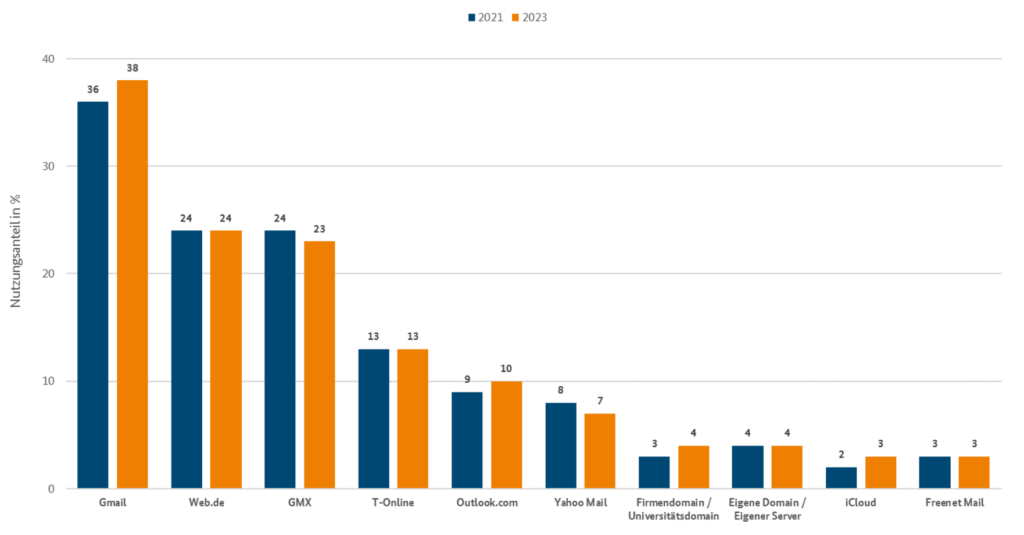
    Wie der Bericht über die Nutzung von Online-Kommunikationsdiensten 2023 der Bundesnetzagentur zeigt, gehören Gmail, Web.de, GMX und T-Online zu den meistgenutzten E-Mail-Providern in Deutschland. Die Mehrheit der deutschen E-Mail-Nutzer*innen lässt dadurch zu, dass große digitale Unternehmen ihre persönlichen Daten nutzen, ihnen Werbung anzeigen und Werbe-E-Mails zustellen.

    Screenshot von “Abbildung 32: Genutzte E-Mail-Dienste” aus dem Bericht über die Nutzung von Online-Kommunikationsdiensten 2023 der Bundesnetzagentur.

    Das mag erstmal ernüchternd klingen, aber was sind denn die Alternativen?

    Selber Hosten?

    Während die meisten gängigen Messenger – wie beispielsweise WhatsApp – ihre Nachrichten über zentrale Server der Unternehmen verschicken, kann durch die dezentrale Natur der E-Mail theoretisch jede*r einen eignen E-Mail-Server bereitstellen.

    Auch, wenn dieses Selber-Hosten eine Option ist (und immerhin 4% der Deutschen E-Mail-Nutzer*innen diese auch nutzen!), bleibt das bis heute vergleichsweise aufwendig. Das Aufsetzen und Verwalten eines Mailservers erfordert gewisses technisches Know-How – oder wenigstens die Bereitschaft, sich längerfristig in das Thema reinzufuchsen – und die Fähigkeit, mit Niederlagen (die dazugehören werden…) umzugehen.

    Außerdem heißt selbst ein perfekt eingerichteter eigener Server – z.B. zu Hause oder bei einem Server-Anbieter – noch nicht, dass Mails automatisch bei Gmail, Outlook & Co. ankommen. Die großen E-Mail-Dienste misstrauen kleinen Servern erst mal: strenge Spam-Filter, fehlende IP-Reputation oder fehlende technische Authentifizierungen (wie SPF, DKIM und DMARC) sorgen schnell dafür, dass Mails im Spam landen oder abgewiesen werden. Auch liegt es in der Verantwortung der Selbst-Hostenden, sich um Datensicherungen zu kümmern.

    Also keine massentaugliche Alternative. Doch was dann?

    Unabhängiges E-Mail-Postfach!

    Eine echte Alternative bieten datensparsame sowie -schutzfreundliche Anbieter aus Europa, die auch mit grüner Energie oder Open-Source Software punkten können. Sogar deren Geschäftsmodelle beruhen auf diesen ethischen Prinzipien.

    Der Wechsel von beispielsweise Gmail zu einem dieser alternativen Dienste ist auch gar nicht schwer! Die unter anderen vom Digitalcourage e.V. initiierte Bewegung des DI.DAY hat dazu auch schon ein passendes Wechselrezept veröffentlicht – wie eingangs bereits erwähnt.

    Dort ist eine detaillierte Schritt-für-Schritt-Anleitung zu finden, um von Gmail zu einem der folgenden europäischen Anbieter zu wechseln (funktioniert i.d.R. genauso für den Wechsel von anderen Anbietern als Gmail):

    Ich habe mich nach einem sorgfältigen Vergleich entsprechend meiner Bedürfnisse für ein Postfach bei mailbox.org entschieden. Ich zahle nun zwar ein paar Euro im Monat, kann aber wieder guten Gewissens schlafen und mit mehr Integrität für digitale Mündigkeit und eine tech-positive Zukunft einstehen.

  • We Don’t Need to Play for Anyone

    We Don’t Need to Play for Anyone

    Reading Time: 10 minutes

    This is a personal reflection written in a moment of clarity — not to convince, but to remind myself of what matters.

    If it resonates with someone else out there, I’m glad, even if just partially. If not, that’s okay too.

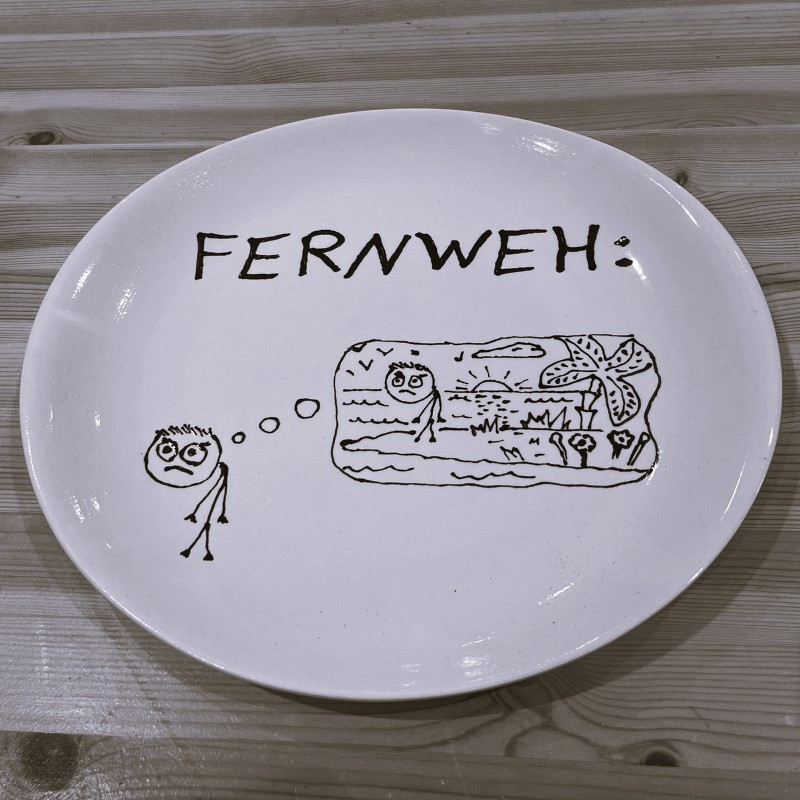
    The Plate and the Trap

    I saw a plate the other day. It had a painting of someone with a gloomy face, dreaming of a tropical island – where the same version of themselves sat, with the same gloom.

    A plate with a painting of someone with a gloomy face, dreaming of a tropical island – where the same version of themselves sat, with the same gloom.
    Seen in the shop window of https://paintyourstyle.eu/category/muenchen-de/.

    It struck me hard. That’s what we do, isn’t it? We fantasize about running away, as if place will fix the thing that is actually mental, spiritual, cultural.

    We’re sick and tired of the constant noise in our cities. We’re fed up with the densely built-up concrete jungle. We long for clean air to breathe. We wonder why the status quo seems to be people rushing instead of people relaxing. We treat each other poorly, hiding behind facades. We’re afraid of wars and insane world leaders. We suffer from injustice. We’re sick and tired of this game of technology. We no longer want to run around. We don’t want to be another puppet on a string.

    I just finished my Master’s. Everyone wants to know what’s next.

    But honestly – I think “next” is the trap.

    Listening Again

    I’ve started listening again. To my mind, to my body and my soul. To the city and to nature. To people. To the earth. To my own nervous system and my heart.

    Thereby I had a listen to this downtempo electronic song by Tober & Tober with a meditative and organic vibe, which resonates very well with my own vibe these days: Concepts of Words. The tune perfectly underlines my thoughts.

    At some point, the song features a quote by Alan Watts:

    Well, I have a sort of suggestion, and that is this: that, before we decide either to save the planet or destroy it, we pause for a moment of silence. I don’t mean that kind of grim silence which one observes when somebody says, “Such-and-such a famous person has just died and we’ll observe a moment of silence in his honor.” And everybody frowns and thinks very serious thoughts. That’s not silence at all! I mean real silence in which we stop thinking and experience reality as reality is. Because, after all, if I talk all the time I can’t hear what anyone else has to say, and if I think all the time – and by that I mean specifically talking to yourself subvocally inside your skull – if I think all the time, I have nothing to think about except thoughts. And so I’m never in touch with the real world.

    Alan Watts (text sourced from https://www.organism.earth/library/document/intelligent-mindlessness)

    Games of Words

    At the end of the day, this is the truth, isn’t it? Nobody – yeah, nobody – knows what and why the fuck all this IS. It is sobering, but thoughts are just combinations of words in the endless space of language – and that itself is just such a thought.

    I’ve been thinking, reflecting, listening, talking, discussing and reading through different perspectives and theories – different games of words, trying to capture all of this. Searching for the meaning and trying to make some sense of it all.

    And I heard this poetry slam one day, making me realize I’m navigating this world wide web of information, this game of language, game of words – in circles.

    Whose Thought Is It Anyway?

    I stumbled across big thinkers, honorable geniuses and prestigious scientists.
    All of them are trying to capture a universal truth.
    But is that really what they are doing?

    We attribute thoughts to thinkers.

    Somewhat strange, as all of us know that it is a common phenomenon to say sentences at the same time or have the same thoughts in discussion groups. We’re having a lively evening with our best friends, fooling around, and suddenly two of us say the exact same thing. Or we’ve just prepared our argument in a philosophical discussion and hope to be the next one who can bring it up, but then we’re sobered when someone else comes up with the idea first.

    We experience that strange lack of knowing when coming up with a thought, whether it has already been thought by somebody else or not. And if we do massive research and do not find that thought anywhere, we appear to be sure to be the first ones with that thought.

    As a consequence, we get highly motivated and some of us write a book or a blog post, publish a paper or compose a song. Others found a startup, build a foundation or organize a club. And lots of us publish our everyday thoughts via social media or through chatting.

    We talk about mind theft and copyright. We play games of power to make sure we are mentioned. We invented patents. We sue people who use similar thoughts. We hold back and disguise progressive thoughts because it is a competition. And we overshare lots of trite or even toxic thoughts of which we think are commonly acknowledged through the internet and in our daily conversations and actions, just to get our egos stroked and stroked again and again.

    We seem so fond of our ego that we always want to have it stroked.

    The Performance of Self

    I find myself in situations over and over again, where I observe I’m hoping to come up as the first one with a real smart thought. And why? Because I want people to acknowledge the combination of words that I just created with the language module of my mind. And I want to win. Using all of my personal context as the foundation.

    But what is my personal context? It is the entirety of my experiences, my knowledge, my feelings, my thoughts, my way of perception.

    That model — my way of seeing, feeling, reacting — is what I call my ego. And it’s my ego that wants to win. To be seen. To be first.

    We seem to play in a system of competition. Even holidays, social events, sports and reading can feel like a competition with social media nowadays.

    Gamification of life.

    Good or bad, but who really wins the game?

    Letting Go of the Ego

    For me, this was fun for a while, but over time I started to feel sick and tired, like I was stuck in a loop. And I felt some inner drive to deliberately step out of this.

    Step back, relax, listen to the sound of the universe.

    I just decided not to decide my next career step, because the word “career” makes me feel like throwing up.
    When I hear that word, I am thinking of a good-looking CV, of a solid narrative, a master plan, an ego that makes sense to everyone. How funny it is that we even reshape our ego based on the company or project we are applying for. We prepare different versions of application letters and different versions of our CVs, depending on where we are applying. Different versions of our ego, in hope one of them will get stroked again.

    I feel tired of the pressure to plan, to perform, and to explain myself. I felt fear of judgment – not only to be judged by an employer, but also by my family, everyday people, and friends.

    I’m no longer interested in being “informed” just to signal that I am informed. Too much noise for me.

    I’m no longer interested in letting a platform or systemic environment influence me such that I believe I need stuff. I like it minimal and calm.

    I’m no longer interested in desperately craving partnered sex or a love relationship. I can enjoy sex alone and love is not dependent on another person.

    I’m no longer interested in not wearing clothes with fringes or fabric pulls. Doesn’t matter to me.

    I’m no longer interested in going to the gym and having a licked lean body. It’s way more fun for me to dance, to be outside and to play sportive games. And to eat cake.

    And I’m no longer interested in showering every day. Makes my skin feel itchy and too dry.

    And most importantly, I am no longer interested in judging people because they are judging.

    A New Confidence

    I asked myself who benefits from my fear of judgment. And the more I think about it, the more obvious it gets.

    I realized that we tend to project these fears onto others as well. It can make us feel uncomfortable when a friend decides to do a sabbatical or someone seems to “just do nothing”, taking a break or just breathing. Or even if someone decides to make “one step down” in the “social class hierarchy”, e.g., from being a well-paid software developer to becoming a football trainer or baker. And we tend to cover that discomfort with judgment and worries, such as:
    “If you just do nothing for a month, then one month will become two, two will become four, four become eight and in the end, you have ruined your chances and you’ll probably never work”, or “Not that you end up lost or unhappy”.

    But I feel compassion for those saying such things, as I thought such thoughts myself and even worried about others in that way as well. And I realized that I actually felt envious, as they were actually listening to their hearts.

    I realized that I don’t need to be accepted by anyone to feel confident. I even start to feel more confident the less I try to get my ego stroked and the more I do what feels right for me and say what I actually think, even if others will probably not understand, or judge me.

    And I feel more confident the less I try to compulsively – almost insanely – leave my comfort zone.

    Following my heart.

    Questioning my inner judge, that was shaped by the outer judges and a system.

    Learning to trust my inner desires and intuitions.

    The foundation is a good vibration.

    The Playground and the Race

    I have lots of privileges being German, white, male, heterosexual, and healthy. It is a bit cynical, but I realized I do live in a first-world playground. At the same time, I know there are many, many threats and so much injustices in this world. And it makes me sad as I am beginning to realize that lots of toxic beliefs from my ancestors – from which I cannot completely detach myself either – have destroyed peaceful, abundant ways of living. I feel a deep sense of responsibility for this DNA-show here on Earth.

    We have lots of options. There are tons of products, masses of jobs and a vast amount of possible activities.
    It happened to me that I drowned in that.

    I was constantly overloaded by information received through my pocket computer – no matter if it was a post by a friend or some news ticker update. I always wanted to be up-to-second, not only because of the fear of judgment, but also because I feared missing out.

    I did sense an inner restlessness, but I didn’t question it as I felt it within others as well. It felt somehow normal.

    But it’s a rat race.

    Drowning in Choice

    I didn’t just observe that phenomenon when using my tiny computer. I also observed it when planning my social contacts and time. Party here, meetup there, holiday here, project there. New people everyday. New philosophical theories everyday. So many thoughts, so little quality. So much noise. Underneath the noise: restlessness, junk, confusions and toxins.

    People fearing the climate crisis. People fearing war. People fearing pandemics. People fearing death. People running around.

    I feel like we tend to drown in noise and fear.

    Back to the Roots, Back to the Heart

    And we seem to forget the basics, our roots.

    “Dig up the ground, plant the yam. Love on repeat.”, as Israel Vibration points out in Dig Up the Ground.

    My truth is: it’s one and a half months now since I graduated and I have no satisfactory plan how to shape my ego for others. And I just started not wanting such a plan anymore. Earth keeps spinning. My mind starts moving. It works just fine.

    Collective Fear, Collective Clarity

    In theory, we know solutions to the current threats and injustices to humanity. But we’re missing collective clarity. We’re lacking a collective mental world model and understanding that would allow us to just collaboratively solve the problems. We lack agency. We’re shaped by information overload, misinformation, noise and ads of recommender systems, which take over the agency for us. But we need agency in a democracy. We must not be lazy or foolish, we must wake up. We’re in a meta-crisis. We’re trapped in hamster wheels.

    We’re lacking a shared vision and beliefs. And we’re lacking clarity, togetherness and purpose. That makes it easy for insanely wicked world leaders who seem to have lost touch with their roots (maybe never have been in touch), trying to make us believe democracy has failed.

    A dark drawing of a theatre scene in caricature-style. In the center, sorrowful shapes of world leaders in black suits with hollow eyes control the masses, symbolized ad puppet-like figures on an earth globe, using strings. Above them looms a giant grayscale fog entity with bloody red eyes, representing depression and self-doubt. Its arms look like strings of fog, steering the world leaders like puppets themselves. Below, on the surface of the globe among the mass-controlled puppet-like dark figures, some vibrant, rainbow-colored human figures stand free, dancing and resisting, their light piercing the fog. The scene is framed by red stage curtains, with fog in the background and light breaking through from the defiant figures. The mood is dark and foggy, but the resistant people bring some light into the scene.
    Image generated using OpenAI’s DALL·E via ChatGPT. Used for non-commercial, satirical purposes.

    But we’re all intelligent!

    Let’s just allow ourselves to step back and relax. And claim back our own agency!

    We don’t need to play for anyone.

    Beyond love, there seems to be nothing at all.

    It’s not a Versus

    Recently, I personally feel as clear as I haven’t in years. And I realized that clarity must not be confused with structure. For me, clarity comes from flow and vibration, supported by a good structure. From aligning with the cosmic rhythm. Aligning with the heart.

    Currently, I’m drawn to simplification and creativity, less noise, more presence and more mindfulness.

    Less explicit knowledge and logic. I mean, we invented computers to relieve us from that.
    More intuition, more implicit knowledge and more wisdom. More alignment and embodiment. Feeling and thinking, dancing and breathing.

    Being human.

    Embracing spirituality.

    Even science, for all its achievements, has not brought us a universal truth. The Enlightenment gifted us powerful tools — observation, reason, experimentation — but in the end, we still don’t know why there was a big bang, what came before it, if consciousness is a thing, or whether we’ve truly found the smallest particles of existence. We keep digging, but the mystery remains. And perhaps that’s not a flaw, but an invitation — to stay humble, to keep wondering, and to open ourselves to the truths that lie beyond logic alone.

    Toward a Soul Revolution

    I am really sure that our collective consciousness is directly intertwined with our individual ones. The change is inner and will manifest in the world.

    The struggle is inner: Chicano, Indio, American Indian, Mojado, Mexicano, immigrant Latino, Anglo in power, working class Anglo, Black, Asian — our psyches resemble the bordertowns and are populated by the same people. The struggle has always been inner, and is played out in outer terrains. Awareness of our situation must come before inner changes, which in turn come before changes in society. Nothing happens in the >real< world unless it first happens in the images in our heads.

    Gloria E. Anzaldúa, Borderlands/La Frontera: The New Mestiza, 1987. Recently seen in Vienna at WEST/WU.

    Following our curiosities, not our fears. I’m sure, the good will come. And I’m sure as the sun will shine, that the constructive models will evolve and they will eradicate the destructive ones.

    Spreading understanding, positivity, love and togetherness.

    So that one day, we really all can live in peace, love and harmony.

    Heaven on earth.

    I know for sure now that I really want to help DNA in all of its manifestations. It has never been that clear. I want to help preserve it, fighting against entropy. And I know for sure now that for that purpose, I need to stay true to myself. In a system that consistently tries to lead me astray. A system which appears to be the most pressing threat.

    I’m sure, we need to find balance within ourselves before we can bring balance to the world.

    Probably, humanity is Noah for DNA and we need to find balance within us as a whole, too.

    Let’s embrace the unknown and step forward with positivity and curiosity.

    Let’s reclaim that which is ours. Let’s reclaim our agency and our freedom. All of us!

    Let’s get the soul revolution rolling!

  • My Change of Perspective through a Semester Abroad Down Under

    My Change of Perspective through a Semester Abroad Down Under

    Reading Time: 19 minutes
    Sydney, Australia (picture taken during my journey).

    In this blog post, I provide some hand-picked insights into my semester abroad in Melbourne, Australia — and how it has changed my perspective on life. As I write this, it has been half a year since I returned to my home country, Germany. It took me some time to process my experiences down under, as well as to reflect on them here, back home.

    Now, when I think of the past year, a warm feeling of contentment flows through my inner being and a hearty grin appears on my face. And there is one sentence that goes through my head over and over again: “What a wild trip it’s been…” During my exchange, so many exciting, stirring, and mind-blowing things happened that it took me a while to process everything and reflect on my thought processes. Some of my fundamental beliefs began to reshape.

    I would love to pour out everything about my semester abroad, straight from the stream of my consciousness, but unfortunately, that would not be possible. Instead, I will try to give a very rough overview of the biggest challenges and most beautiful memories.

    Taking the Plunge

    When my family members, friends, and fellow students ask me about my stay in Australia, I often struggle to accurately express my thoughts and feelings about it. Sometimes, I feel a strong urge to advocate for doing a semester abroad, provided the opportunity arises. However, most of the time, I worry that I might express it the wrong way and unintentionally achieve the opposite effect — especially because I recognize this kind of defensive reaction in myself when someone tries to convince me of something. I must admit that I was one of the last people in my close circle of friends to spend a semester abroad, and I always felt a little uncomfortable with their enthusiastic experience reports.

    As a result, I initially rationalized why a semester abroad was unnecessary: it is too expensive, too uncomfortable, and too harmful to the climate; my English is not good enough; I could not learn a new language; wanderlust is just a manifestation of inner dissatisfaction; I can experience other cultures and countries through the internet; I have obligations within my well-established social circle; I have too many other struggles to manage (such as my master’s thesis); and so on — just to name a few of these (ir)rationalizations. I felt anger when my friends told me about their experiences in Canada, France, Spain, Norway, or the US. But at some point, I realized that I actually envied them — thanks in no small part to the group therapy I had started about a year before my stay abroad. I swallowed my pride and took a big step out of my comfort zone. I began planning my semester abroad in Australia — and today, I can proudly say: I went through with it!

    As journaling has helped me for almost two years to tame those ephemeral soap bubbles of thought and cultivate them through language before they burst or disappear on the horizon, I believe that writing about all of it could support me in overcoming the struggle of expressing my thoughts and feelings I mentioned earlier. From my point of view, this is the perfect way to share my personal experiences. I do not want to give intrusive recommendations or pushy advice — I just want to share what this journey has done for me and how I feel and think about it.

    The Semester Abroad

    Before diving into my personal experiences down under, let me first put this whole thing into a technical context. If you are already familiar with the concept of studying abroad for a semester, feel free to skip this section and move directly to My Semester Abroad.

    A semester abroad is not only a fantastic opportunity to visit another country and engage with its culture but also an enormously valuable personal experience that guarantees growth. Students who decide to undertake such an adventure typically face challenges such as applying for a program at both their home and exchange universities, preparing for the organizational and regulatory requirements of entering and staying in a foreign country, navigating and expressing themselves in a foreign language, building new relationships and routines, being physically separated from friends and family, adapting to another culture, and handling a potentially very different academic teaching style. All of this can be overwhelming, if not downright frightening — and it would be a lie to say that planning and managing such a project is not time-consuming as fuck. But students who have been fortunate enough to have such an experience — including myself — usually say it is worth the effort and time. Most would gladly do it again (and some actually do).

    Many universities offer programs that support their students financially and help organize their stay, making such a trip affordable and relatively straightforward. For example, the Ludwig Maximilian University of Munich (my home university) offers an inter-European exchange program called Erasmus+ and an international one called LMUexchange, among others. Students typically start by applying for such a program at their home university. If accepted, they then apply to the foreign exchange university within the program. Afterward, they hope to be accepted there as well, so they can begin the actual preparations, such as applying for a visa, getting insurance, and so on. Depending on the type of program, the number of applicants and other organizational factors, the entire process — from the initial application to finally entering the host country — can take up to a year. But from what I have seen, most students say it is absolutely worth being patient and showing perseverance.

    Experience Reports
    "I am a master's student in physics at the University of Bologna, spending one year abroad studying medical physics at LMU Munich. It was a challenging experience since studying abroad allows you to learn material in different ways rather than being limited to a single method or learning it to a specific depth. It pushes you to adapt to new approaches that may not exist at your home university. For example, at the University of Bologna, we don’t have seminar-based courses, but here, they are part of the curriculum. This experience has helped me develop the ability to convey my knowledge concisely and effectively within a limited time frame. Beyond the academic challenges—such as adapting to new professors and their different teaching styles—you also learn to interact with people who have different social behaviors and levels of friendliness. Studying and collaborating with them adds another valuable dimension to the experience. If I could go back in time, I would do it again. Spending a year abroad is an opportunity for personal growth. It helps students develop in multiple dimensions and become more well-rounded individuals."
    — Amin
    "Hi, I studied AI for one semester at Monash University in Melbourne, Australia. I think a semester abroad is totally worth it because it highlights how unique and strange your life is compared to the vast number of different life circumstances you will encounter. I would certainly like to do it again since I appreciate the change of perspective that comes with it."
    — Leo
    "During my exchange semester in Norway, I had my first contacts with cybersecurity, which would later become the field of study for my master's degree from which I'll graduate and start a job soon. I had the opportunity to experience a country that I've never been to before from an entirely different perspective than I would as a tourist. Even though there are things that – looking back now – I wish I would have done differently or at all, I still think it was a very worthwile time that will always be a good memory."
    — Thomas (Personal Website)
    "During my studies in Social Work in Graz I did an semester abroad in Munich. The university supported Erasmus students a lot, this is why they offered separate courses in English. We were 12 students from all over Europe. I shared an appartment with most of them. Therefore I gained a lot of experience and spoke English most of the time. I would recommend to do an semester abroad because of the intercultural exchange and the personal growth (becoming more independent and self-reliant). Because of the same native language (German) I got to know locals very easy. I am still in good contact with my friends from Germany. Due to the local proximity we see each other regularly. I am very grateful for that."
    — Carina

    My Semester Abroad

    Now I am going to share the most interesting insights from my semester abroad. Instead of linearly describing all events like in an autobiography, I want to focus on the experiences I found most meaningful and impactful for my personal journey.

    For the sake of clarity and context, here is a brief overview of the key events: I was still conducting research for my master’s thesis when I flew to Melbourne. After arriving, I had three weeks for personal and academic orientation before the semester at Monash University (my exchange university) officially started. During this time, I met some interesting people, visited beautiful places, and became somewhat familiar with Australian culture as well as with my roommates. Throughout the semester, I balanced my coursework at Monash University, which I attended in person, with the remote research for my master’s thesis at Ludwig Maximilian University of Munich. I wrote my last exam at the beginning of June. Since my supervisor and I decided to write a paper, which we submitted to a conference in mid-June, I had six weeks left to travel around Australia before my visa expired. I used this time to explore Tasmania, Cairns, Sydney, and Brisbane before flying back to Munich.

    The Other Hemisphere of Planet Earth

    It is one thing to understand astronomy and observe the sun’s changing course throughout the seasons from the same position on Earth. But it is an entirely different experience to change that position and perceive all the differences that come with it. The same applies to geography and distance: Imagining traveling to a place more than 16,000 km away is one thing, but grasping it through lived experience is entirely different.

    The Flights

    On the evening of February 4, 2024, I started my flight from Munich via Dubai to Melbourne. The whole trip took 23 hours, and I saw two beautiful sunrises in 18 hours. Because of the time shift, it was already the morning of February 6, 2024, when I arrived in Melbourne. So, I technically skipped a day by flying in the same direction as the Earth rotates. Moreover, I started in the cold of winter and arrived in the heat of summer. I did not sleep very well on the plane, so the jet lag was horrible, especially since I was a little sick. I had never experienced jet lag before, as my longest flight had been to Tenerife, and I can say that I underestimated it. It took me longer than a week to fully recover and adapt to the new rhythm, season, and climate. In Germany, everything was cold, bare, and grey, but suddenly, from one day to the next in Australia, everything was hot, green, and colorful. That experience was mind-blowing, even though it might sound trite or obvious.

    When flying back, I had a very similar yet different experience. On the evening of July 30, 2024, I started in the more northerly and thus warmer Brisbane and flew back in the opposite direction as the Earth rotates. After another stop in Dubai, I arrived back in Munich. This time, I did not technically skip a day, but I kind of surfed on a stretched one, so I landed on the next day, namely July 31, 2024. Neither the jet lag nor the seasonal change was as bad this time.

    The Course of the Sun

    In the first few weeks, there was something else that confused me, and I just could not figure it out. It also seemed trivial as I did, because I was aware of it in theory, but still, it was something completely different to actually observe and experience. One morning, I was enjoying my breakfast in the backyard of my shared house when I suddenly realized that the sun was moving in the opposite direction than I was used to. Obviously, the sun moves from east over south to west in the northern hemisphere. Therefore, if I point at the sun with my right index finger and follow its course, I move my arm from left to right. However, in the southern hemisphere, the sun moves from east over north to west. Thus, if I point at the sun with my right index finger and follow its course again, I move my arm from right to left. As I said, it is obvious, but still, it was such a cool personal observation, and it actually made me happy and even more curious.

    One Intercontinental Flight Away

    It was a really weird thought that none of my family members and friends were physically reachable anymore. So far, I had always lived in the same city as my family on my father’s side, and I had lots of friends with whom I could physically spend time. But now, all of a sudden, everyone with whom I had a deep relationship was literally on the other side of the globe. At first, I was scared and worried about feeling lonely, but actually, I did not. My roommates integrated me very well, and I felt a sense of belonging. I also started having regular phone calls with my family members and best friends. Of course, I missed them. Paradoxically, probably because of the necessity for more mindfulness regarding the scheduling of video calls and the design of the conversations, some of my friends and I have become even closer through the physical distance. What a time to be alive.

    Living with Different Cultures

    Honestly, I had never been that interested in other cultures before, as I was more of a nerd when it came to topics related to natural sciences. However, being exposed to the multitude of cultures down under completely changed my mind.

    Living in Australia with People from Kashmir

    I lived in Clayton, a suburb of Melbourne – the capital of Victoria – located to the east of its Central Business District (CBD). I decided to live there for two reasons. First, Monash University is also located there. Second, there was a housing crisis in Victoria, and it was rather hard to find accommodation. I had actually planned to live with native Aussies to get closer to their culture, but unfortunately, I could not find such accommodation due to the crisis. Plans always change. After an exhausting search from overseas, I was lucky to find a shared house on Browns Road with two people from Kashmir – one former and one current computer science student at my exchange university.

    After my arrival, my two roommates gave me a warm welcome. They drove me to a department store to get some bedding and convenience items. Afterwards, we had a long conversation over tea, and I started to get to know not only the Kashmiri culture but also Australian culture, as they had already lived there for years.

    During my stay, we cooked and had barbies (Australian slang for “barbecue”) together, took trips to national parks, a thermal spa as well as the Great Ocean Road, and had long philosophical discussions until the middle of the night. They told me about their very political and emotional perspective on the Kashmir conflict, about life in Kashmir, the beauty of nature there, about being Muslims, and they introduced me to the culinary world of Pakistan, Kashmir, and India. I also joined them for one day of fasting during Ramadan. I am deeply grateful for this exchange.

    Another Approach to Work-Life-Balance

    What I found particularly interesting was their different approach to work-life balance, which was not strictly based on the week and weekend but actually took place every day, relatively independent of the weekly concept. They alternated between working productively and chatting or chilling out every day. They just lived and went with the flow. As a result, they were very spontaneous, which was a sharp contrast to my German planning behavior. Adapting to this way of life while achieving my personal goals was a significant challenge. However, now that I am back in Germany, I find myself planning less and living more in the moment. I am convinced that overcoming this hurdle has shifted my perspective, showing me that planning does not always lead to happiness. Plans always change. Life cannot be fully planned – it just can be lived. Furthermore, I think that spontaneity is a crucial part of my inner well-being and satisfaction. After reflecting on it and living life back in Germany, I now know that a balanced mixture of sticking to plans and going with the flow is desirable for me.

    Another Way of Life

    Their relationship to spirituality and religion is another aspect I was curious about, which made me reflect a lot. They are Muslims, so the all-encompassing aspect of their lives is religion, namely Islam. As I am vegan with a weakness for butter chicken, it was easy to get along regarding halal food. And because I stopped drinking alcohol more than two years ago, this was also not an issue. Their belief in God kept them going, and the prayers in the mosque or at home were rituals of gratitude and mindfulness. I was almost shocked by how content and fulfilled they always seemed, even when they had struggles at work or university, and how they always encouraged me when I expressed concerns about my master’s thesis and the paper – “Don’t worry! You’ll be alright.” Never before in my life have I met such frugal and optimistic people who seemed full of fulfillment and hope. It seemed to me that they were using a tool-set from their religion for the psyche and self-care techniques that Westernized and very naturalistic people could also benefit from without having to join Islam or any other religion directly. I hope that, in the future, such healthier alternatives to popular substances (especially alcohol) for managing overthinking and negative emotions will emerge, offering long-term mental health benefits to Western society. After this experience, I am no longer a strict naturalistic atheist but rather an agnostic, and I have developed a new sense of aesthetics and spirituality, which I am still exploring.

    Cultural Mixer

    I was truly culture-shocked in a completely different way than I had expected when I learned about ethnic enclaves, which are common in metropolitan areas of Australia. In my first week, I drove to the neighboring suburb of Springvale, and suddenly I felt as though I was somewhere in Asia, as the majority of the people there appeared Asian, and there were almost only Asian markets and restaurants. Later, my roommates informed me that seeing a majority of a specific ethnic group is a phenomenon typical of Australian suburbs. In the case of Springvale, many Vietnamese people migrated there during the Vietnam War in the 1970s and 1980s and collectively settled in the area. This phenomenon can also be observed in other suburbs of Melbourne, such as Oakleigh, which has a strong Greek cultural influence, or Carlton, which is also known as “Little Italy.” However, even though not every Aussie would agree, it seemed to me that almost everyone embraced the Australian cultural values of talkativeness, openness, curiosity, and respect. In the CBD, all different cultures merged together, creating a strong, internationalized unity. I did not expect the strong characteristics of the different cultures at all, as I am not used to ethnic enclaves in Munich. Here, it seems to me that there is a predominant German culture, and other cultures do not have the same opportunity to flourish as they do in Australia. I completely understand the arguments for preserving local culture, but I have my doubts that this cannot go hand in hand with allowing other cultures to unfold and shine brightly as well. I had never considered this before my semester abroad, but now I appreciate cultural exchange and integrated cultural curiosity as fundamental values for myself.

    International Encounters

    Throughout my entire stay in Australia, I also got to know many people from different countries around the world. At Monash University, there were activities and events for international students like me, which helped me socialize and make international connections. I met people from Sweden, Malaysia, China, the US, Great Britain, Canada, India, Pakistan, Kashmir, Poland, Mexico, Argentina, Italy, Denmark, the Netherlands, and, of course, other Germans. I could find Germans literally everywhere, and the same applied to Brits. Sometimes I just had superficial chats, and sometimes I had deeper conversations and connections. Later, when I traveled around Australia, I also met lots of internationals in hostels or at free walking tours. Sometimes we scheduled small trips or activities together. In hindsight, I remember a handful of valuable encounters that I will probably never forget.

    One of them was a stimulating conversation with a young Jewish woman from Canada on a bus tour through the Daintree Forest near Cairns. She started by asking me about my greatest fear, and we talked for almost two hours. She confided in me that she is very worried about the safety of Jews worldwide, especially after observing the recent hostility and conspiracy theories surrounding Jews all over the globe, as well as the situation in Gaza and Israel. I was shocked when she pointed out that she would not feel safe in Germany at the moment and would not recommend Jews going there. I was speechless, and I still don’t know what I can do about it other than standing firm in my opposition to the political right.

    Another young woman from Canada inspired me with her personal international experiences. We spent a few days together and visited the Three Sisters in the Blue Mountains. She was the same age but had traveled much more than I had. She was born and grew up in Brazil, studied in Switzerland and France, and is now teaching in Canada. It was impressive how her English was almost accent-free and with what ease she told me about commuting internationally to visit her parents in Brazil or her boyfriend in India. I was also impressed by her open mind and psychological resilience, which was likely a result of the many fresh starts in her life. I envied her courage and curiosity, but I am optimistic about integrating these values into my personal life as well.

    Speaking and Thinking a Foreign Language

    I have never been bad at English in school. Plus, during my studies, I had some opportunities to learn and improve my English. I wrote my bachelor’s thesis in English, attended some lectures held in English, and participated in an English course at my home university to prepare for Australia. I also communicated entirely in English with my master’s thesis supervisor, which was good practice as well. I thought I was well-prepared.

    However, when I arrived in Australia, I realized that my English was clustered around formal and technical vocabulary. At times, I felt like a toddler when I spoke. I struggled with basic words needed for daily life, like rash, capsicum, floss, inflammation, and more. I especially lacked vocabulary related to my emotions and feelings, and since expressing those is important to me, I felt frustrated and uncomfortable. For this and other reasons, I went to a free psychological coaching session at the health center at Monash University in the fourth week of my stay, where I had the chance to express my thoughts and feelings and receive professional support. It also helped me prioritize my goals and deal with the initial overwhelm I felt during the semester abroad. Afterward, I started learning important English words related to emotions and feelings and began to talk about them regularly with my roommates or friends at university. By the way, the word “friend” is a false friend for non-Aussies, as most of us think of it as referring to someone with whom we have a deep connection, but a “friend” in Australia can be anyone you just met and spend some time with.

    Over time, I learned more and more words, and speaking English became easier. At some point, I even started thinking in English, and it became harder to switch back to German when I spoke with my friends and family on the phone. Besides words, I also learned Aussie slang, which often trivializes many words – for example, arvo for afternoon, brekky for breakfast, avo for avocado, barbie for barbecue, devo for devastated, or defo for definitely. The thing I struggled with the longest, and still hadn’t fully mastered by the time I left, was the countless idioms and the Australian accent. But at least I could hold conversations with natives, which was my biggest progress in terms of English understanding and speaking. I was delighted every time Aussies or Brits praised me for the quality of my English.

    Studying in Melbourne

    I had to attend three courses at Monash University. The teaching style was quite different compared to that at Ludwig Maximilian University of Munich. It was very school-like, meaning I had to do homework every week, some of which was even a hurdle and was included in the final grade. This required a lot of learning effort and left little free time during the semester, compared to my experiences in Germany. Moreover, I had to conduct research for my master’s thesis and paper. On top of that, I wanted to enjoy the semester abroad. It was a lot at once, but having clear goals and structure in my daily life helped me deal with it all to my satisfaction. My ambition, combined with the pressure I put on myself, was a borderline challenge in itself, and I think I almost burned out, which I somehow managed to avoid thanks to the great integration by my flatmates and the exciting experiences in and around Melbourne. This aspect of my experience abroad has sustainably strengthened my resilience, perseverance, patience, and trust in myself. Now, I can proudly say that I reached all of my goals: I passed all of my exams well, I passed my Master’s thesis summa cum laude, I co-authored a paper published at EMNLP 2024, I enjoyed my semester abroad, and I had many astonishing experiences.

    Traveling Australia

    I spent most of my semester abroad in Melbourne due to academic obligations. During this time, I made smaller trips to the beach, the CBD, the rainforest in the Dandenong National Ranges, the Great Ocean Road and more. In the last six weeks of my stay, I traveled to Tasmania, Cairns, Sydney, and Brisbane before flying back home to Munich. I was alone in Tasmania and went on a road trip (driving on the left side). I was worried that I might suffer from loneliness, but I actually enjoyed it and found my mind clearest when watching the sunrise at the Bay of Fires or eating some cookies on top of Mount Amos, with only myself for company. The nature in Tasmania is truly beautiful and often untouched. Afterwards, I met some friends from Monash University in Cairns and started to enjoy the company of other people. For me, sleeping in an 8-bed dorm was a big step out of my comfort zone, but I am glad I did it, as I became more and more comfortable with chatting with people until I finally found joy in it. I managed to get comfortable with my social anxiety. I am going to show some of my favorite impressions in the images inside the toggles below.

    The Flora Down Under
    The Fauna Down Under
    The Cities Down Under

    Conclusion

    In conclusion, I can say that the semester abroad in Australia was a very valuable experience that I would definitely do again if I had the chance. It really stretched my comfort zone. As a result, I became much braver and more comfortable with my social anxiety. I became incredibly more curious about other cultures and beliefs. Moreover, I found so much inspiration regarding different ways of life that I am actively integrating them into my own life now – or at least trying.

    It shifted my perspective on what really matters in life, and I found out that it does not actually make me happy to spend eight or more hours a day in front of a screen solving complicated algorithmic puzzles on my own. It also does not make me happy to blindly chase after any capitalist promises of prosperity or sacrifice myself as a workhorse for some narrow-minded project or research. I did not only learn about the incredible value of social connections, but also about the importance of experience in the real world — traveling, culture, art, religion, history, and politics. There is this world out there, and this curiosity inside me.

    "The important thing is not to stop questioning. Curiosity has its own reason for existing. One cannot help but be in awe when he contemplates the mysteries of eternity, of life, of the marvelous structure of reality. It is enough if one tries merely to comprehend a little of this mystery every day."
    — Albert Einstein

    I had an initially sad realization that has since made me extremely grateful and even happy. I have realized that, over the years, I have chosen a career path that is the ideal avoidance strategy for social contact and allows me to solve introverted algorithmic puzzles every day without having to get out of my comfort zone much. At first, I thought I had to leave computer science in order to be happy at all. However, after a long process of reflection, I realize that less extreme paths will probably suffice. After all, I am now a computer scientist, and even in this field and research, there are opportunities to choose more or less introverted work as well as more or less narrow-minded work. Since returning to Germany, I have been seeking much more social contact as well as purpose and am now integrating this into my work-life organization.